
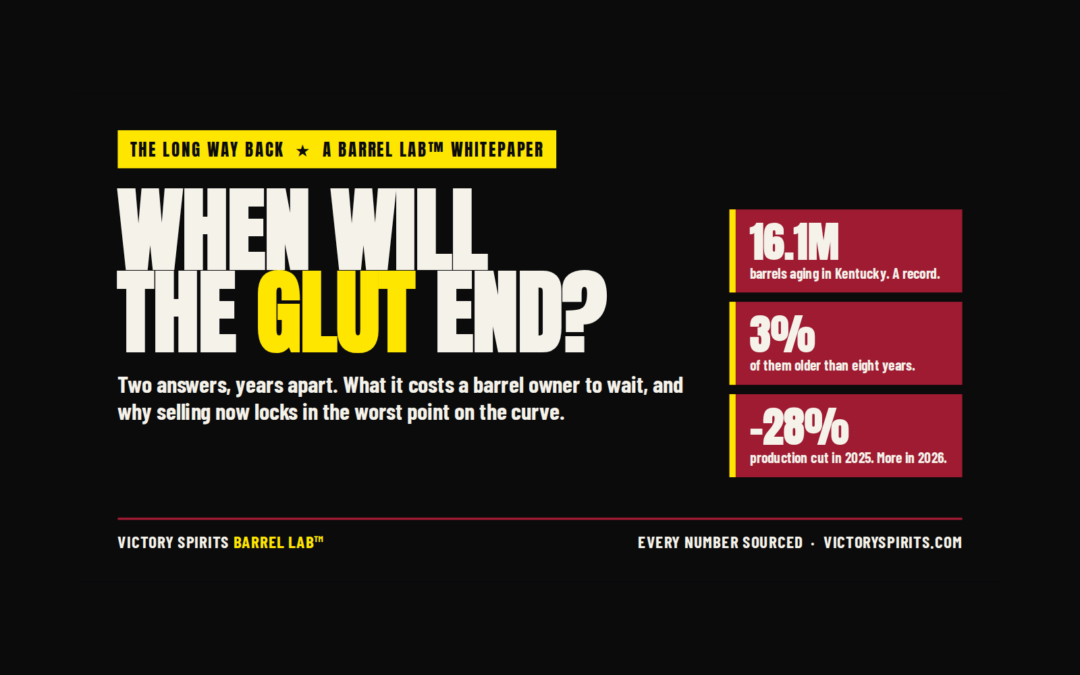
The Long Way Back · A Victory Spirits Barrel Lab™ Whitepaper
When Will the Glut End?
When the bulk whiskey market stabilizes, and what barrel owners should do until it does. Every number sourced. No number invented.
The short version
The bulk whiskey market will stabilize in stages, and the last stage is further away than most people think.
The forced-sale tier that sets today's bid for young bourbon clears in 2026–2027. Total inventory is a different story. Even after the biggest production cut in memory, Kentucky is still filling a little more whiskey each year than leaves its warehouses, so the pile has not started to shrink. Getting back to a normal seven or eight years of cover takes fills near 1 million barrels a year. With a recovery in exports that lands around 2033; without one, closer to 2040. The squeeze on old whiskey also comes later than the headline cuts suggest: the most eight-year-old bourbon Kentucky has ever had arrives in 2031, and the cuts show up as scarcity in 2033 and 2034.
Distillers filled 3.2 million barrels in 2023 and 3.03 million in 2024, then slammed the brakes. American whiskey volume is 30.0 million cases, 4% off its 2022 peak. Only 54% of American adults drink at all, the lowest Gallup has measured since 1939.
Here is the fact the headlines miss: 70% of Kentucky's inventory, 11.4 million barrels, is under four years old, and only 3% is older than eight. The glut is a glut of young whiskey. The barrels not filled in 2025 and 2026 are the eight-year-olds that will not exist in 2033 and 2034.
For an owner whose barrels would only sell today below original cost: do not sell into a forced-sale bid. Model the carry cost to age eight (about $65 a barrel a year in cash for whiskey over four years old, before evaporation; the math is in Section 5). Hold the barrels that have a standard mash bill, verified provenance and more than one possible bottler. And consider the one exit that does not depend on the bulk market at all: bottling.
1. The glut is real: 16.1 million barrels and counting
Kentucky warehouses held 16.1 million barrels of bourbon on January 1, 2025, plus about a million barrels of other spirits, the most in the state's history. The Kentucky Distillers' Association put the tax bill at $75 million for 2025, up 163% in five years, on inventory assessed at $10 billion.
The inventory grew 11% in the last reported year alone, and it is young. KDA's February 2026 economic report says more than 70% of it, 11.4 million barrels, was produced in the past four years. Only 3% is older than eight years. Nationally, the U.S. spirits industry holds about 1.5 billion proof gallons, three times the level of a decade ago.
What the chart does not show is why the pile grew so fast. Part of it was planned: a boom that ran from 2012 through 2022 pulled fills up every year. Part of it was not: Kentucky bourbon lost about $500 million in exports to retaliatory tariffs after 2018, Canada delisted American spirits in 2025, and Brown-Forman reported Canadian sales down 60%. Whiskey that was distilled to be bottled and shipped overseas is still sitting in the rickhouse.
2. Who is drinking: demand is off its peak, not off a cliff
Americans bought 30.0 million nine-liter cases of American whiskey in 2025, down 1% on the year and 4% below the 2022 peak of 31.2 million. That is still 79% more than in 2012. Supplier revenue was $5.1 billion, down 0.9%. The category is not collapsing; it stopped growing after a decade in which it never once shrank.
The worry is the next cohort. Gallup's 2026 survey found 54% of U.S. adults drink, unchanged from 2025 and the lowest since it started asking in 1939. Among adults 18–34 the figure fell from 58% in 2023 to 50% in 2026. Every age group declined over those three years, including 55+, which had been the lone holdout in 2025. Fifty-one percent of Americans now say one or two drinks a day is bad for your health, up from 27% in 2001.
Two things cut the other way. Young adults who do drink now name liquor (38%) as often as beer (36%), a share shift toward spirits inside a shrinking pool. And exports are the swing factor: American spirits exports fell 9% in the second quarter of 2025 and Canada, once 10% of American rye exports, “disappeared.” A trade settlement would put that volume back faster than any change in domestic habits.
What this means for supply. At 30 million cases a year, allowing for proof-down and bottling yield, the industry draws roughly 1.3–1.6 million barrels of aged whiskey a year, domestic plus export. That figure is our estimate, not a published statistic. Against 16.1 million barrels in Kentucky alone, it is ten to twelve years of cover. The historical comfort zone was six to eight; in 2019, before the biggest fill years, Kentucky held about six.
3. The fill curve: the biggest cut in memory, and not enough
Kentucky distillers filled 1.7 million barrels in 2018, crossed 2 million in 2019 for the first time since 1967, and did not stop: 2.44 million in 2020, 2.62 million in 2021, 2.7 million in 2022, a record 3.2 million in 2023 and 3.03 million in 2024. Then they slammed the brakes. Venture First, which valued 555,000 barrels in 2025, puts the 2025 cut at 28% and 2026 at another 20% or more, taking output back to roughly 2017 levels. TTB data for January–April 2025 showed whiskey production down nearly 28%, the lowest since 2019. Jim Beam idled its Clermont campus for all of 2026.
The line is the number nobody publishes directly: how many barrels leave Kentucky's warehouses each year to be bottled or shipped. It can be backed out of the KDA's own figures. Take the inventory on January 1, add that year's fills, and subtract the next January's inventory. For 2019 that arithmetic gives 1.35 million barrels, and the KDA separately reported about 1.36 million emptied that year, which is how we know the method works. It gives about 1.5 million a year for 2021 through 2023, and only 1.23 million for 2024 as sales slowed. We use 1.45 million going forward.
Now read the right side of the chart. On the announced cuts, fills fall to about 2.2 million barrels in 2025 and 1.75 million in 2026. If they settle near 1.6 million after that, they are still above what leaves the warehouse. The gap shrinks from 1.8 million barrels a year in 2024 to about 150,000, but the pile keeps growing: roughly 17.15 million barrels on January 1, 2027, and still rising.
What it takes to get back to normal. Before the boom, Kentucky held about six years of whiskey against what it drew down: 8.5 million barrels against 1.35 million in 2019. Today it holds eleven. Getting back to eight years, about 11.6 million barrels at today's withdrawal rate, means working off more than 5 million barrels. That takes one of two things, and realistically both: fills cut to around 1 million barrels a year, and demand, most likely exports, recovering.
| Path | Fills from 2027 | Leaving the warehouse | Inventory peaks | Back to 8 years of cover |
|---|---|---|---|---|
| A. Cuts as announced | 1.6M a year | 1.45M a year | Does not peak | Not on this path |
| B. Cut to 1 million | 1.0M a year | 1.45M a year | 17.15M, Jan 1 2027 | About 2040 |
| C. Cut to 1 million, exports return | 1.0M a year | 1.7M a year | 17.15M, Jan 1 2027 | About 2033 |
When the old whiskey actually gets scarce. A barrel turns eight on a fixed schedule. The 2018 fills turned eight this year; the record 2023 fill turns eight in 2031. So the most eight-year-old Kentucky bourbon there can be rises every year through 2031, peaks at 3.2 million barrels, and only then falls, to about 2.2 million in 2033 and 1.75 million in 2034.
Those are ceilings, not forecasts. Many of the 2021–2024 barrels are being bottled or sold young right now, and every barrel pulled early is one fewer eight-year-old later. Today only 3% of Kentucky's inventory is older than eight, so eight-year-old whiskey is scarce now and will stay relatively scarce for a few more years. But the direction is set: the big fill years reach eight from 2029 through 2032, and the cuts of 2025 and 2026 buy real scarcity in 2033 and 2034, not in 2029.
4. What a barrel is worth in a forced sale
The same barrel has three prices right now, and the spread between the first and the third can exceed everything the barrel has earned since it was filled. That is Venture First's finding from 42 valuations covering 555,000 barrels in 2025, and it is the single most important fact for anyone deciding whether to sell this year.
| Basis | What it means | Who sets it | Where it sits today (young bourbon, 2–5 yr) |
|---|---|---|---|
| Fair market value | Willing buyer, willing seller, neither under compulsion, reasonable time to market | Brand buyers, orderly bulk trades, VRV | At or modestly above cost to produce |
| Orderly liquidation | A controlled wind-down, net of the cost of getting it sold | Lenders, workouts, broker-run sales | Below cost |
| Forced liquidation | Compressed timeline, and the buyer pool knows it | Receivers, bankruptcy court | Well below cost; new-fill trading around $450 a barrel |
The forced tier is what the headlines quote. MGP, the largest bulk supplier in the country, reported brown-goods sales down 59% in the second quarter of 2026 on top of a 52% decline for all of 2025. Uncle Nearest, Westward and Kentucky Owl have all been in bankruptcy court arguing with lenders over what their barrels are worth. Independent bottlers describe “some pretty fire-sale prices out there.” New-fill bourbon changes hands near $450 a barrel, close to what it costs to make.
What the headlines leave out is the age curve. Venture First's transaction data shows 8+ year barrels still commanding premium prices from brand buyers even as the broad middle clears at cost. Age no longer raises the floor, but it still raises the ceiling. Recall the KDA age profile: only 3% of Kentucky's inventory is older than eight years, about half a million barrels. The market is not saying bourbon is worthless. It is saying young bourbon with no obvious home is worthless today, and paying up for the thing that is scarce: proven age with a path to a bottle.
Exposure time is now the biggest single driver of price. A barrel that must sell in 30 days trades in the forced tier. The identical barrel with a year to find its buyer trades near fair market value. The discount is not a statement about the whiskey. It is the price of the seller's deadline.
5. Holding to 2030: the owner's playbook
Waiting costs about $65 a barrel a year in cash once the whiskey is past four years old, plus the whiskey the angels take.
That is the number to weigh against a forced-sale bid, and for most cost bases it is small next to the spread between the forced tier and fair market value. The carry inputs below are real 2026 rates. Kentucky storage with insurance now averages $3.75 a barrel a month for whiskey up to four years old and $5.00 a month for barrels over four, which is where every barrel in this table sits for the whole hold. Add Kentucky's ad valorem barrel tax at the 2025 industry average ($75 million across 17.1 million barrels, about $4.40 a barrel) and evaporation at 3% of volume a year (a rule of thumb; higher on hot upper floors, lower in palletized ground-level storage). Your own warehouse rate replaces the first line.
| Cost basis per barrel | Cash carry per year (age 4+) | Cash carry, 4 years to 2030 | Evaporation, 4 years (in kind) | Break-even sale price in 2030 |
|---|---|---|---|---|
| $600 | $64 | $258 | 11% of volume | $970 |
| $900 | $64 | $258 | 11% of volume | $1,310 |
| $1,200 | $64 | $258 | 11% of volume | $1,645 |
| $1,500 | $64 | $258 | 11% of volume | $1,985 |
| $1,800 | $64 | $258 | 11% of volume | $2,325 |
Break-even here means recovering cost plus carry on the whiskey that remains, with no return on capital. A 2022 fill bought at $1,200 needs about $1,645 a barrel as an eight-year-old in 2030. Today's forced-sale bid for the same barrel is well under $1,200; today's fair-market comp for a seven- to eight-year-old with a standard mash bill is well above $1,645. The risk, which Section 3 spells out, is that a 2022 fill turns eight in 2030 alongside the largest eight-year-old cohorts Kentucky has ever produced, so today's comp is not guaranteed to hold. The decision is whether the owner can fund about $65 a year, and whether the barrel has a buyer or a bottle waiting when it gets there.
Four rules for the wait:
- Do not sell into a forced-sale bid. The gap between fair market value and forced liquidation now exceeds the barrel's entire appreciation since fill. Time is the only lever that closes it.
- Hold the barrels with more than one buyer. Barrels with a standard mash bill, verified provenance and several possible bottlers trade like a commodity with a floor. Barrels with one buyer (a single brand, one distillery's niche mash bill) trade like Uncle Nearest's.
- Model to age eight, not to the next quarter. The asset that still commands a premium is an 8+ year barrel with a brand offramp. A 2021 fill becomes that asset in 2029; a 2022 fill in 2030. Only 3% of Kentucky's inventory is there today, but expect company: the biggest fill years on record turn eight from 2029 through 2032.
- Bottling is the exit that does not need the bulk market. Private label and single-barrel programs convert a bulk asset priced at cost into a finished good priced at retail. With the bulk market not back in balance until the 2030s, it is the only route whose timing the owner controls.
What would change this view: a trade settlement that restores Canadian and EU volume is the single biggest lever (Path C in Section 3). A cut in fills to around 1 million barrels a year is the other; without it, inventory does not fall at all. A further step down in the drinking rate below 54% pushes everything back. The 2021–2023 cohort is the one to watch. It is three to five years old now, in the tier that clears at cost. It turns seven to nine in 2028–2032.
What are your barrels worth in an orderly market?
Barrel Lab™ lists bulk spirits in the barrel from Kentucky, Indiana and Tennessee producers with verified provenance and a real value, not a fire-sale bid. Licensed buyers enter with a DSP permit.
Enter Barrel Lab6. Method and sources
Method. Supply figures are Kentucky-only, from the KDA's annual barrel reports (inventory as of January 1; fills for the prior calendar year). Kentucky produces about 95% of the world's bourbon, so the national picture is larger but moves the same way. Demand is DISCUS American whiskey volume (all styles; DISCUS does not publish a bourbon-only figure). Barrels leaving the warehouse for 2019–2024 are backed out of the KDA's own numbers (January 1 inventory plus the year's fills, minus the next January 1 inventory); the 2019 result, 1.35 million, matches the 1.36 million the KDA reported emptied that year. These are our estimates and are labeled as such in the text: annual barrels drawn to bottle going forward (1.45 million, within a 1.3–1.6 million range), fills for 2025–2028 (the announced 28% and 20% cuts applied to the 2024 base, then held near 1.6 million), and the three inventory paths in Section 3, which vary only fills after 2026 and the withdrawal rate. The carry-cost table uses observed 2026 Kentucky rates and states each assumption.
- Kentucky Distillers' Association, The Bourbon State: Challenges Continue Amid Record Barrel Inventory & Skyrocketing Taxes, Oct 8, 2025 (16.1M barrels, $75M tax, $10B assessed)
- KDA, Kentucky Distillers Set Records for Bourbon Barrel Inventories, New Fills, Sep 2022 (2021 fills 2,619,633; 11.4M aging); The Proof Is Here: More Than 10 Million Barrels, 2021 (2020 fills 2,437,603; 10.3M aging); Nearly 10 Million Aging Barrels, Oct 2020 (2019 fills 2,122,954; 9.27M aging)
- NKyTribune, KDA announces record number of newly-filled barrels, Dec 2023 (2.7M fills, 12.6M aging Jan 1 2023); Kentucky tops 9 million barrels, Nov 2019 (8.5M bourbon aging Jan 1 2019)
- Distillery Trail, KDA Sounds the Alarm as Tariffs Loom, Dec 2024 (14.3M aging Jan 1 2024; 3.2M fills); Kentucky Bourbon's Economic Impact Grows to $10.4 Billion, Feb 4, 2026 (2024 fills 3.03M; 70% of inventory under four years, 3% over eight)
- Bourbon Banter, Kentucky Distilleries Fill Record Barrels in 2019 While Emptying Relatively Few (2018 fills 1.7M; ~1.36M barrels emptied in 2019)
- Lexington Herald-Leader via Yahoo Finance, As sales slow, barrel inventory hits new record, Oct 9, 2025 (production down 28% Jan–Apr 2025; 1.5B proof gallons nationally; exports down 13%); Spectrum News, Distillers group reports skyrocketing barrel taxes, Oct 8, 2025
- DISCUS, 2024 American Whiskey Category Fact Sheet (volume 2003–2024); 2025 Support Tables, Feb 5, 2026 (29,996k cases, $5,129M); Annual Economic Briefing 2025
- Gallup, Americans' Drinking Remains at Record Low, Aug 20, 2026
- Venture First, Valuing Barrels in a Declining Market, Sep 22, 2026
- The Bourbon Flight, MGP Ingredients' bourbon sales plunge 59%, Aug 12, 2026; Focus on Risk, A Market in Transition: The 2026 Bourbon Industry, Jan 29, 2026 (new-fill ~$450); VinePair, The Whiskey Glut Won't Lower Prices, Apr 21, 2026; Reuters, Bourbon Demand Is Down and Tariffs Aren't Helping, Apr 7, 2026
- Carry inputs: Kentucky storage-plus-insurance averages observed by Victory Spirits, Sep 2026 ($3.75/bbl/month to age four, $5.00/bbl/month over four); KY barrel tax average = $75M ÷ 17.1M barrels