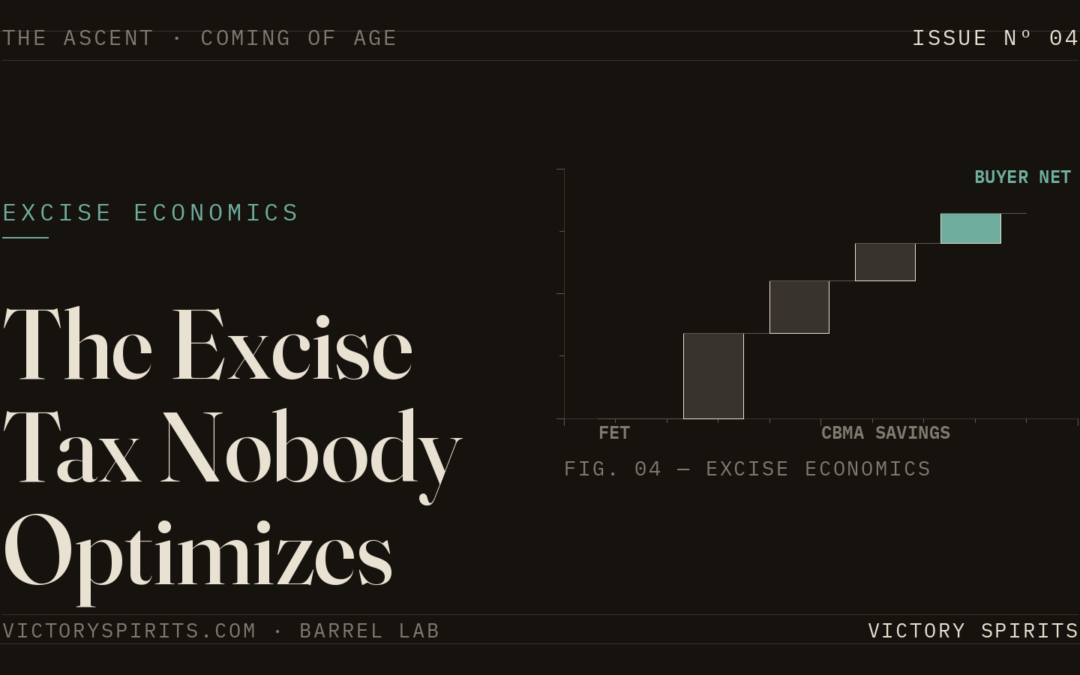
The federal excise tax is the largest line item most barrel buyers treat as fixed.
It isn’t.
And the money left on the table doesn’t vanish — someone collects it.

There is a number attached to every proof gallon of distilled spirits that leaves bond, and for most of the industry’s history it was simply a fact of life: the federal excise tax, paid at the standard rate, treated as immovable as gravity. Then Congress made it movable. The Craft Beverage Modernization Act created dramatically reduced rates on an initial band of production — and in doing so, turned a fixed cost into a variable one for anyone sophisticated enough to structure around it.
Most buyers are not. And that is the quiet scandal at the center of the barrel economy: the single largest cost in the transaction is also the one most often left unoptimized. The savings are real, they are substantial, and they do not evaporate when they go unclaimed. They accrue to whoever in the chain understood the mechanics better than the person across the table.
How the tax actually works
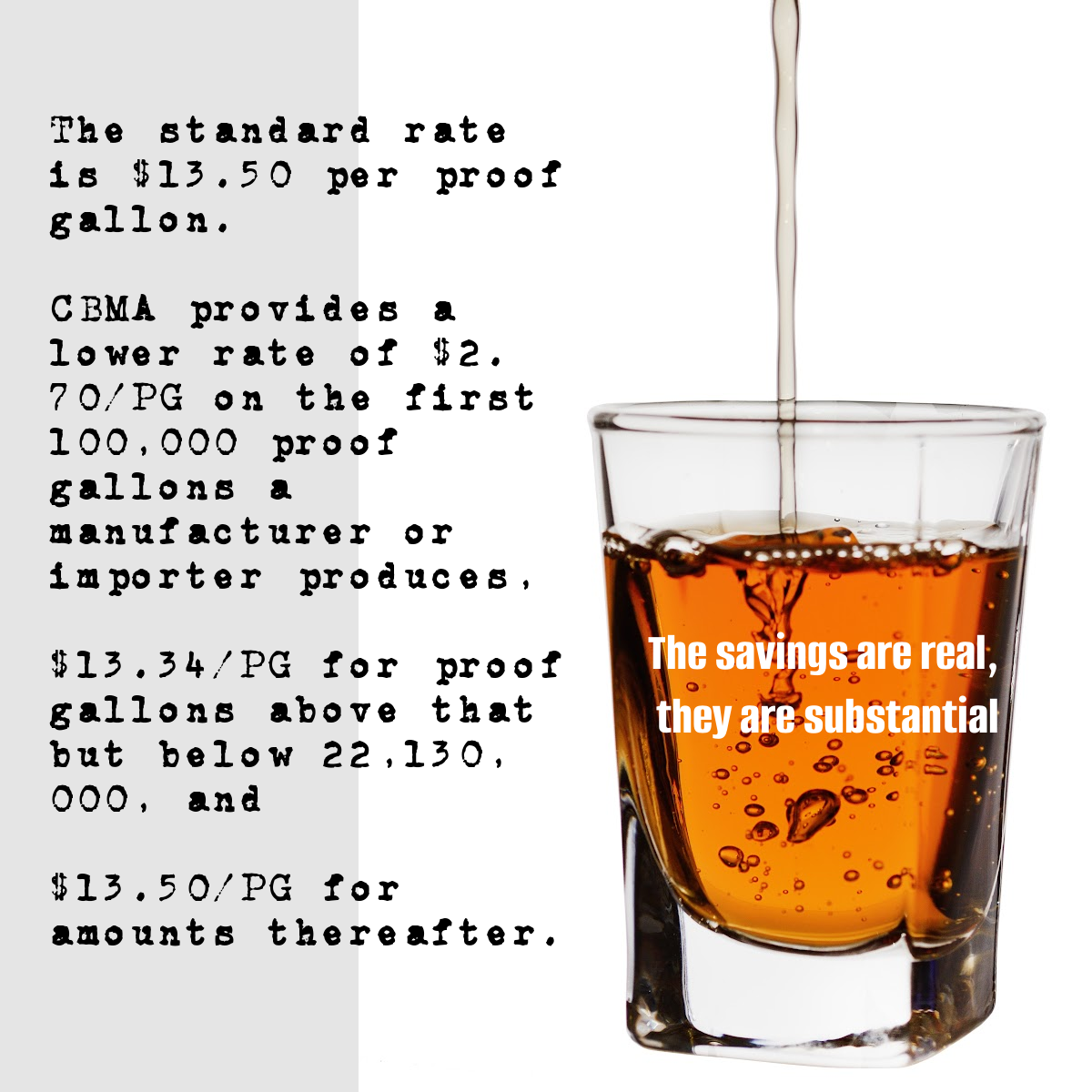
The standard federal excise rate on distilled spirits is $13.50 per proof gallon. That figure is doing a lot of work in the economics of a barrel, because a barrel is not sold by the unit — it is sold by the proof gallon, the measure of pure alcohol it contains. A higher-proof barrel carries more proof gallons, more sellable spirit, and more tax. The excise line scales with exactly the thing you are buying.
What CBMA changed is that the first tranche of proof gallons a producer removes from bond each year is taxed at a steeply reduced rate rather than the full $13.50 — a difference that, across a meaningful volume, is not rounding error. It is one of the largest levers in the entire cost structure.
But the lever only pays out if the transaction is arranged to capture it: who holds the spirit in bond, who removes it, who pays the tax and when, and how the reduced-rate allocation is assigned. Get the structure right and the savings are real. Get it wrong — or never think about it — and you default to the full rate and hand the difference to someone else.
Why the sophisticated capture it and everyone else doesn’t
The reduced rate is not a secret. It is federal law, public and available to anyone. And yet the benefit concentrates, because capturing it requires understanding a stack of mechanics that most buyers never learned: transfer in bond, the timing of tax determination, how the reduced-rate quantities are controlled and assigned, and how all of that interacts with the specific structure of a given deal.
This is the same asymmetry that runs through every part of this market, applied to tax. The buyer who does not understand the excise machinery cannot see the money in the deal. He sees a price and a barrel. He does not see that the way the transaction is structured determines whether thousands of dollars of savings land in his pocket or someone else’s. And because he cannot see it, he cannot negotiate for it. The excise surface stays hidden from the party least equipped to read it — which is precisely the party that should benefit from it.
That is what “unoptimized” really means here. It is not that buyers overpay in the abstract. It is that a concrete, legislated saving exists in the structure of nearly every transaction, and most of the time it goes uncollected by the buyer simply because it was never made visible to him.
Making the excise line legible
The fix is not clever tax gymnastics. It is transparency applied to the one line item everyone treated as fixed. When the excise position of a barrel is surfaced alongside its price, its proof, and its provenance — when the buyer can see not just what a barrel costs but what its tax structure actually is — the savings stop being the private advantage of the sophisticated and become a shared, negotiable part of the deal.
This is why the excise question sits so close to the center of what a reference layer should do. A legible market does not just tell you what a barrel is worth. It tells you what it will actually cost to bring across bond, including the part of that cost that is variable and, structured correctly, sharply reducible. A platform that understands the mechanics can pass that understanding to the buyer instead of quietly capturing it — and can structure the transaction so the savings are realized rather than defaulted away.
There is a model in this that aligns incentives rather than exploiting them. If a buyer captures excise savings he would otherwise have left on the table, and the party that made those savings possible shares in them, both sides come out ahead of where the opaque market would have left them. The buyer nets more than he would have. The platform earns from value it created rather than value it extracted. That is a fundamentally different economic relationship than the one the barrel trade has run on — and it is only possible once the excise line is visible to everyone at the table.
The tax is not fixed. It never was, not since Congress made it a variable. The only question is who is paying attention — and in a market built on opacity, the answer has almost always been: not the buyer. That is the next thing to change.
(The mechanics here are the shape of the opportunity, not tax advice; the right structure for any given transaction depends on its specifics and its counsel.)
The Ascent — Coming of Age. A bi-weekly series on the structure and future of the bulk whiskey market, from the team building Victory Spirits Barrel Lab.